Post In:
- Attendance Management


HelixtaHR is India's leading HRMS software for payroll, leave, attendance and employee management — smart, AI-first HR technology designed to simplify work for businesses.
Contact Info
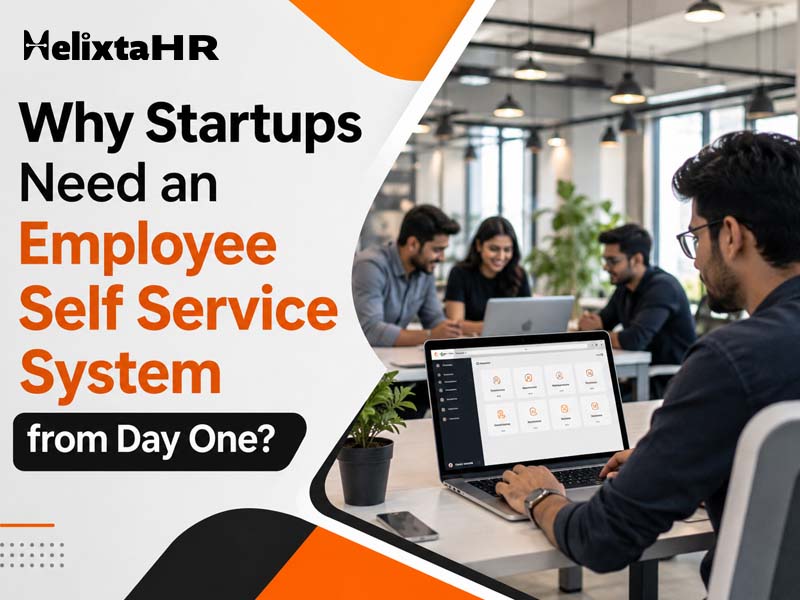
Most startups begin small and HR consists of the entrepreneur struggling with the payroll sheets amid other activities. This is okay with a few employees. Once the number reaches a point of being over ten to fifteen employees, that very approach becomes difficult to manage and this is why the implementation of an Employee Self Service solution known as ESS HRMS should be part of the founding toolkit.
An ESS HRMS is a system that lets employees handle basic HR tasks on their own, without routing every small request through a founder or an HR person. Checking a leave balance, downloading a payslip, or updating a phone number becomes something an employee does directly, instead of sending a message and waiting for someone to respond.
For a startup, this isn’t a luxury feature reserved for larger companies. It’s a practical way to avoid HR becoming a bottleneck before the business has even found its footing.
Most founders assume Employee self service tools are meant for companies with a dedicated HR department, not a ten-person team still figuring out its product-market fit. This assumption tends to backfire.
Setting up proper systems early avoids a much harder cleanup later, when the company has grown past the size where informal processes still work.
Without a system in place, small HR tasks pile up in ways that aren’t always obvious until they’ve become a real problem.
None of these problems feel urgent when a startup has five employees. They become genuinely disruptive by the time that number reaches twenty or thirty.
Good HR Software brings structure to a team before that structure feels necessary, which is exactly the point. Instead of building processes reactively once something breaks, a startup with the right system in place scales without needing to redo its HR setup from scratch every time it grows.
This becomes particularly important once a startup starts hiring across different roles and locations. A system that already handles employee records, attendance and basic HR functions in one place means growth doesn’t automatically translate into more manual work for whoever happens to be handling HR at the time.
Payroll tends to be one of the first instances where the manual system truly affects the new venture. The reason is that Payroll Software eliminates one of the biggest areas of potential error and stress by automating the computation of salary and statutory deductions rather than using a formula created once in a spreadsheet.
For a new venture in their first couple of payroll cycles, this mistake could cost dearly as far as employee trust is concerned. A missed PF deduction or an incorrect payslip is a bad first impression to make with a small, tightly-knit team.
Leave tracking sounds simple until a startup has more than a few people requesting time off in overlapping ways. Leave management software solves this by keeping leave balances accurate and approvals traceable, instead of relying on a founder’s memory or a shared calendar that nobody consistently updates.
This matters even more for early-stage teams, where every person missing tends to be noticed immediately. Clear, self-service leave tracking avoids confusion about who’s actually available on a given day.
For startups that have teams that work remotely, one might expect that attendance tracking is not something that will come up until they have an office. In reality, attendance management software will be used much sooner than expected, especially when the team has people who are working different shifts or in different time zones.
It will save you from some embarrassing moments down the road and it will give you a good look at how your team really operates.
There’s a cultural argument here too, beyond pure efficiency. Startups that give employees Employee self service access from day one are signaling something about how the company operates — that information is accessible, that processes are transparent and that employees aren’t expected to chase down basic answers.
An ESS HRMS isn’t about adding complexity to a young company. It’s about avoiding the kind of complexity that builds up quietly through manual processes, until a founder suddenly finds themselves spending more time on HR admin than on the business itself. Startups that invest in proper HR Software, Payroll Software, leave management software and attendance management software early tend to scale more smoothly, simply because the systems were already built to handle growth before growth actually arrived.
statutory compliance, payroll accuracy and employee self-service already built in.
Get your team set up right from day one — book a free demo with HelixtaHR today.
